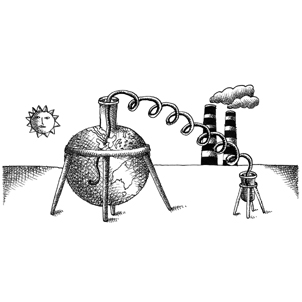
The smartest way to cut pollution is to prevent it. That’s the motto of “green” chemistry, a relatively new initiative to devise processes that avoid the use and generation of hazardous substances. In the chemical industry, the proverbial ounce of prevention is worth more than a pound of cure - in fact, thousands of times more. For some high-value chemicals, up to a thousand kilograms of waste are generated to produce one kilogram of a useful material. In the United States alone, the chemical industry annually releases more than 3 billion tons of chemical waste, some of it toxic, into the environment. The industry then spends some 150 billion dollars every year to comply with laws for waste disposal. In research that may help keep our planet clean while reducing the need for chemical waste management, Weizmann scientists are studying alternatives to some of the chemical industry’s “dirtiest” processes.
Just Add Oxygen
Oil is not only the major energy source on our planet but also the basis for producing a host of essential chemicals and materials, ranging from pharmaceuticals to plastics. A central process used for deriving these substances from oil is oxidation, a reaction in which a substance - in this case oil - interacts with oxygen. However, common industrial oxidation methods are highly polluting. One striking example is the production of propylene oxide, a basic oil-derived chemical with an annual world market of some $5 billion, which is needed for the manufacture of many types of plastics, including the materials used in compact disks and hothouse coverings. A significant amount of propylene oxide is produced in an oxidation reaction involving chlorine, a poisonous substance that is not incorporated into the final product and ends up as chemical waste. Up to 300,000 kilograms of chlorine left over from this reaction are shipped to incinerators or landfills every year, creating a serious environmental hazard.
Prof. Ronny Neumann of the Organic Chemistry Department heads a research program that focuses on “green” oxidation, a process that would leave behind no hazardous waste. In this approach, oxygen obtained from air is used as a reactant, with water being the main waste product.
The air we breathe is an obvious source of oxygen. However, under regular conditions oxygen in this most common form hardly reacts with organic materials. (This is fortunate for the living beings on our planet, since otherwise life could not be sustained in Earth’s atmosphere.) In contrast, at high temperatures things head to the other extreme: organic materials do react with oxygen, but they tend to burn, or combust. One of the goals of green chemistry is to design controlled, mild, “middle-of the-road” conditions for chemical reactions, in which oxygen from air would be used to obtain desired products. To make this happen, scientists employ catalysts - substances that, though added only in minute amounts, speed up chemical interactions and channel them in a particular direction. Neumann’s lab designs such catalysts and catalytic systems, and studies the mechanisms of oxidation catalysis.
One of Neumann’s projects is aimed at developing a pollution-free process for the preparation of propylene oxide. The process, which makes use of oxygen obtained from air, is made possible by a catalyst based on the metal ruthenium. The scientists have already shown that this reaction works in the laboratory and described its mechanism. Their next goal is to adapt the reaction for industrial use.
The new understanding of oxidation mechanisms achieved in Neumann’s research can also serve an additional goal of catalysis: the ability to selectively manipulate oxidation reactions or other chemical processes. In one project, Neumann and his colleagues seek to halt the transformation of alkyl aromatic substances at a selected stage. Normally, this reaction continues until it results in the production of aromatic acids, but Neumann wants to interrupt it in the middle in order to obtain intermediate products called aldehydes. The result could be a selective and pollution-free method for producing these substances, which are used to manufacture a host of products with a huge market value: agrochemicals; flavor and fragrance additives such as lilac, anise, and vanilla; and materials needed to make penicillin and other pharmaceuticals.
Clean Technique
The chemical, agrochemical, and pharmaceutical industries make extensive use of oil-derived substances called aromatic alkenes. Today, however, standard industrial methods for producing aromatic alkenes require the use of toxic compounds - chlorides, bromides, or iodides. Moreover, thesemethods create enormous amounts of different salts, which can pollute underground water reservoirs. Some methods also release into the environment significant amounts of carbon dioxide, a greenhouse gas largely responsible for global warming.
Prof. David Milstein of the Weizmann Institute’s Organic Chemistry Department and his team are developing an entirely “green” method for producing aromatic alkenes: source materials undergo oxidation with the help of oxygen, and the only “waste” product is water. In addition to being environmentally friendly, the Weizmann method - designed by Milstein together with graduate student Haim Weissman and postdoctoral fellow Xiaoping Song - is economically attractive: aromatic alkenes are produced in a single reaction, directly from the inexpensive hydrocarbons, arenes and alkenes. The approach thus eliminates the need for multistep processes and the costly intermediate chemicals currently used in industry to obtain aromatic alkenes.
The new method was developed when scientists set out to study ways of deriving complex, high-value chemicals from basic hydrocarbons. In one experiment, they mixed arenes with a certain alkene and added a catalyst based on the metal ruthenium to speed up the reaction. The reaction produced a substance belonging to the subtype of aromatic alkenes called cinnamates. Worldwide production of cinnamates stands at 10,000 tons a year, about half of which is used in the manufacture of sunscreens; other uses include the production of odorants and foodstuffs. The Weizmann Institute team is currently studying the mechanisms involved in the reaction as well as designing ways to apply the new method to aromatic alkenes other than cinnamates. The scientists are also seeking to improve the method to make it suitable for industrial use.