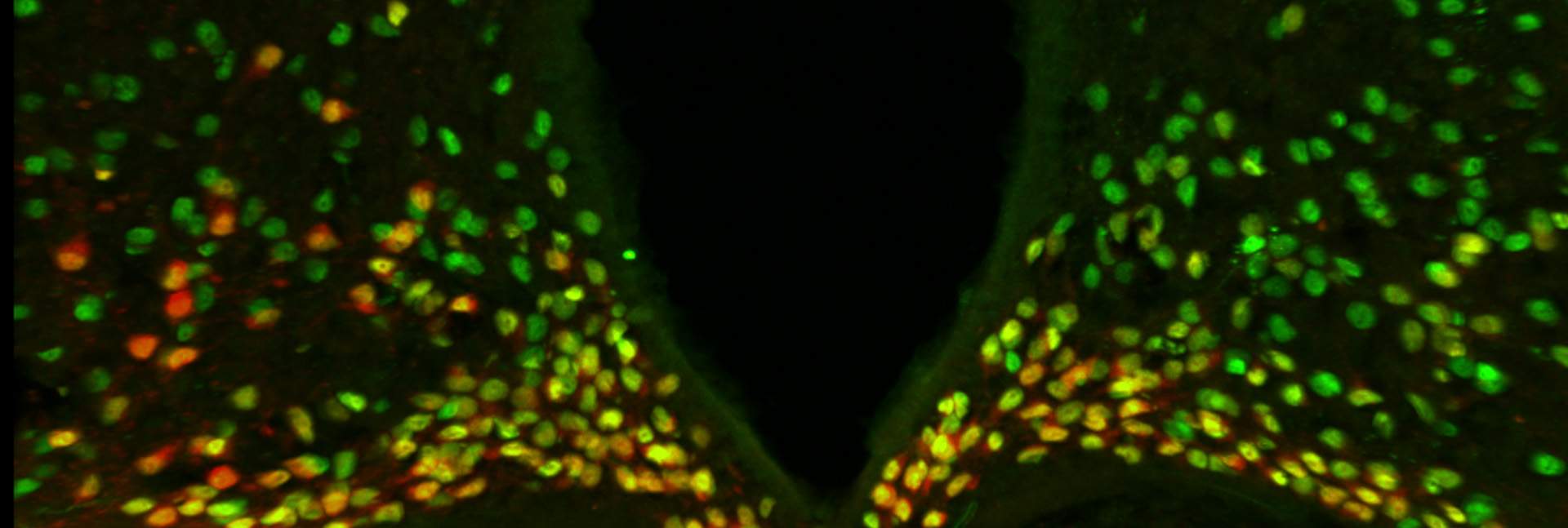
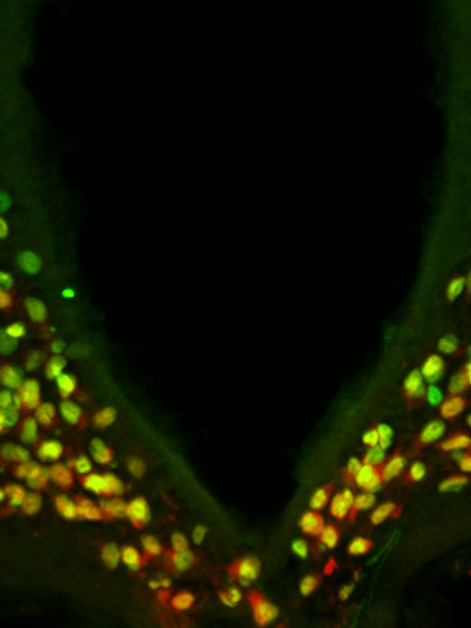
Many of us find ourselves losing our appetite – or, conversely, overeating – in difficult situations, and these common reactions to stress suggest that our mind and our metabolism are deeply connected. A new study from the Weizmann Institute of Science reveals a previously unknown biological link between mental and physiological stress responses: They are orchestrated by a single “mastermind” gene, a kind of master switch that is active in the brain even before birth.
The study, published recently in Endocrinology, shows that this gene, called Orthopedia, or Otp – long known to play a key role in building the developing brain – remains active into adulthood, helping regulate key hormonal systems that determine how the brain controls stress, metabolism and even behavior.

“We found that the same genetic program that shapes the brain’s wiring during embryonic development continues to play a central role in regulating the organism’s stress response and energy balance throughout its lifetime,” says Prof. Gil Levkowitz, whose team conducted the study in collaboration with the lab of Prof. Alon Chen.
The Otp gene, which acts within the cell nucleus, is so essential that when it is removed from a mouse embryo, the mouse will not survive. In previous research, Levkowitz and his team primarily studied Otp in the zebrafish, which carries two versions of this gene with overlapping functions, allowing the fish to survive when one is disabled. More than a decade ago, the team showed that disrupting one Otp gene during brain development creates a life-long effect, preventing the fish from mounting a proper stress response in adulthood. They also found that the protein made by the Otp gene is present in the adult fish brain, which suggested that the gene keeps working after the brain is formed. But what it does in adults remained unclear.
""We have identified a new master regulator of balance in the brain and body"
In the new study, the researchers opted for mice as their research model, to get a better understanding of how Otp affects the brain and metabolism of mammals, including ourselves. They focused on the hypothalamus, a small but crucial brain region that keeps our basic survival functions – from hunger and sleep to reproduction and stress – in balance. It does this by releasing chemical messengers that act both within the brain and throughout the body. “We tend to call them hormones when they affect body organs, and neuropeptides when they act on the brain, but in both cases it’s the same molecule,” Levkowitz explains.
The team engineered a genetic tool that allowed them to selectively switch off Otp in specific cell groups in adult mice, without disturbing brain development. In a series of experiments led by staff scientist Dr. Yael Kuperman and students Maayan Tahor and Tali Nahum, they asked a fundamental question: Does this gene still matter in the adult brain?
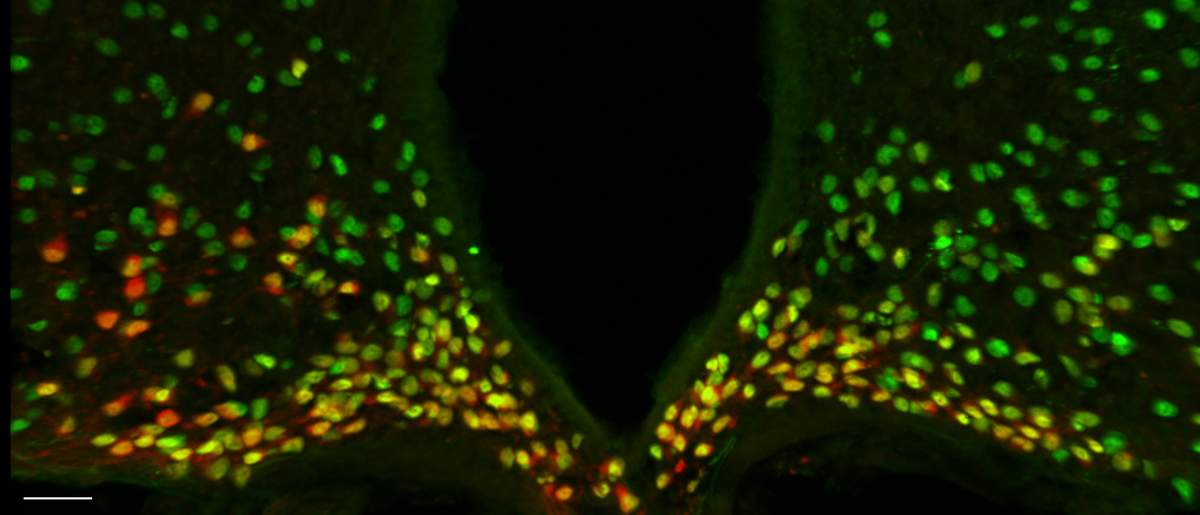
The answer was a resounding yes. When Otp was disrupted, the mice’s stress systems went into overdrive. They released extra corticosterone and other stress hormones and showed depression-like behavior: The mice developed poor stress-coping behaviors, seemed to withdraw and quickly gave up in the face of stressful challenges. Their resilience to stress appeared to collapse.
At the same time, their metabolism went off balance. Their thyroid hormone levels fell and, as a result, body temperature dropped and cholesterol levels increased. The mice ate normally and weighed about the same as controls, yet they accumulated more body fat and their response to hunger signals weakened.
“We found that Otp acts like a central control hub in the adult brain,” says Kuperman. “It operates in stress-related cells and in cells that control the thyroid system, which affects metabolism throughout the body.”
In humans, Levkowitz notes, these systems often go hand in hand. “Depression or anxiety can look purely psychological, but in some cases, a blood test reveals low thyroid hormone levels. That can influence stress, but also cholesterol, blood sugar and overall metabolism.”
At the cellular level, Otp works like a switchboard operator. It picks up signals arriving from the body and from the outside world and routes them to DNA, deciding which hormonal systems to activate and how to respond to changing conditions. “It is a multitasker that integrates incoming signals in the nuclei of cells,” Levkowitz explains.
From an evolutionary point of view, the findings reveal remarkable efficiency. During development, Otp controls the production of substances that help brain cells specialize. Later in life, the same machinery is repurposed – now to deal with daily challenges, from stress to shifts in energy balance. “A molecule we once thought of purely as a developmental regulator turns out to be a master regulator of physiological balance throughout life,” Levkowitz says. “It’s not just building the system – it keeps it running.”
At the same time, the study revealed a great level of complexity, showing that Otp helps preserve a delicate balance among a multitude of components. It does not control a single pathway but several at once, sometimes producing opposing effects. In the hypothalamus, for example, it can stimulate the expression of peptides that drive hunger as well as those that call for energy expenditure, while maintaining the system’s equilibrium.
“Otp is part of a complex network,” Kuperman explains. “It can affect antagonistic cell populations in different regions of the hypothalamus, and it seems to help maintain the balance between them.”
The study opens a new perspective on disorders of brain and metabolism. It suggests examining them in light of a basic question: Are certain problems with stress resilience or metabolism rooted in early development, or do they result from a regulatory breakdown that emerges later in life?
Looking ahead, scientists may be able to target specific branches of the network controlled by Otp, rather than trying to fix the whole system at once. “We have identified a new master regulator of balance in the brain and body,” Levkowitz says. “Understanding in greater detail how it works may one day lead to more precise ways of treating different aspects of stress and metabolic dysfunction – not by shutting the system down when something is not working properly, but by nudging it back into balance.”