The Wolfson Building for Biological Research
Architects: Benjamin Idelson, Gershon Zippor, Nahum Zalkind and Moshe Harel
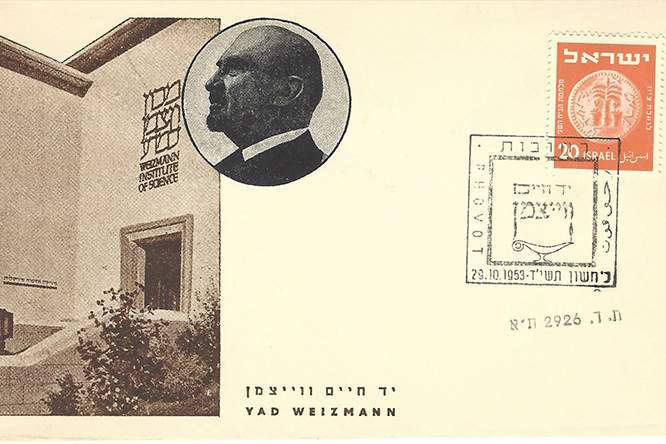
The Wolfson Building for Biological Research was designed by the architects Benjamin Idelson, Gershon Zippor, Nahum Zalkind and Moshe Harel in 1968 as a six-story building. This is one of the most massive buildings on the campus of the Weizmann Institute of Science. Yet, despite its height, it projects a reserved modesty accentuated by its straight lines. In the spirit of architectural Functionalism, its business-like appearance derives from the purposes it serves. In 1983, the architect Gershon Zippor, who had been responsible for planning the original building, added two more floors. Since the architect and builders managed to secure the services of the same quarry that had supplied the stone for the facing of the first five floors, the addition has not affected the appearance of the façade.



On the façade, two long horizontal stone rows demarcate each floor, with a row of windows between them. The building’s entrance has a prominent canopy, which in the spirit of Functionalism has an additional purpose: it serves as the floor of the large balcony on the level above, where scientists can get together informally. In contrast to the building’s light external stone and the Functionalist style, the entrance lobby, designed by Rafi Blumenfeld and Lazar Hizkiya, surprises the visitor with its elaborate wooden walls of threedimensional trapezium panels.

The observer can spend several minutes trying to figure out how the unique three-dimensional effect is produced by a mere juxtaposition of these panels. This wooden wall, however, is not just for artistic and aesthetic purposes; it creates a partition between the building’s lobby and the lecture hall, although only a sharp eye will detect the hall’s two doors hidden in the wooden wall: even their protruding handles match the three-dimensional trapezium pattern. The woodwork also serves the acoustic purpose of absorbing noise from the lobby, as does the wall tapestry woven after a painting of Adam and Eve by Jean David.