[[Skip Header and Navigation] [Jump to Main Content]
« עברית
  • Home
  • News
    • Press Releases
    • In the News
    • Subscribe to Press Releases
    • Honors and Awards
    • Visits
    • Events

    Press Releases

    17 Jun 2013
    Mice in a “Big Brother” Setup Develop Social Structures
    16 May 2013
    Weather on the Outer Planets Only Goes So Deep
    18 Apr 2013
    Neural Activity in Bats Measured In Flight

    More »

    Research Highlights

    germ cells
    Alternate Endings
    A newly discovered cell-death pathway could help fight cancer
    side effects
    Side Effects

    “Feel-good” drugs like Prozac may have an unwanted side effect: diabetes

    overgrown leaf
    Limits to Growth

    Most of the many factors for determining leaf size turn out to put on the brakes, rather than promote growth

    More »

    Honors & Awards

    Prof. Israel Pecht will be awarded an Honorary Doctorate Degree in Biology from National and Kapodistrian University of Athens
    More »

    Full list »

    |
    | | | | | |
    |
  • Research
    • By Subject
    • What We Are Doing About:
    • From Basic Research to Benefiting Humanity
    • Shaping the Future

    By Subject

    Alternative Energy Materials Science
    Astrophysics Mathematics
    Biochemistry  Molecular Cell Biology
    Bioinformatics Nanoscience
    Biomedical Biology Neuroscience
    Cancer Particle Physics
    Chemistry Physics
    Computer Science Plant Sciences
    Environment Quantum Physics
    Evolution Scientific Archaeology
    Genetics Structural Biology

    What We Are Doing About:

    • Cancer
    • Diabetes
    • The Environment
    • Nanoscience
    • Energy

    Benefiting Humanity

    Prof. Amos Breskin
    Prof. Amos Breskin develops advanced radiation detectors, which have an important impact on many fields of research, such as particle, nuclear and atomic physics, medical diagnostics, biology and materials science.
     
    Application

    More »

    Full list »

    |
    | | | | | |
    |
  • Magazines and Multimedia
    • Annual Report
    • Interface - Online Magazine
    • The Weizmann International Magazine of Science and People
    • Books
    • Nano Comics
    • Galleries
    • Horizons - Online Magazine
    Annual Report 2012
    The 2012 Report
    Annual Report 2012
    2012 and Beyond
    Research Highlights
    New Developments
    Technology Transfer
    Summary of Operating Results
    More »

    Magazines

    Current Issue: Spring 2013
    Interface magazine Spring 2013
    Magazine Sections
    Science Feature Articles
    Made at the Institute
    Time Tunnel

    Archive »

    Latest Videos

    CRASH
    The Race for the Higgs Boson
    • Monitoring Carbon Exchange
    • Thanks for the Memories
    • Quantum Computing
    • Back to Basics - Forward to the Future
    More »
    |
    | | | | | |
    |
  • About the Institute
    • Overview
    • History
    • Virtual Tour
    • Visiting the Institute

    Overview

    • Multidisciplinary Research
    • Facts and Figures
    • Pioneering Progress
    • Training Future Scientists
    • Science is for Sharing
    • Advancing Israel
    • New Horizons
    • Beauty in Science

    History

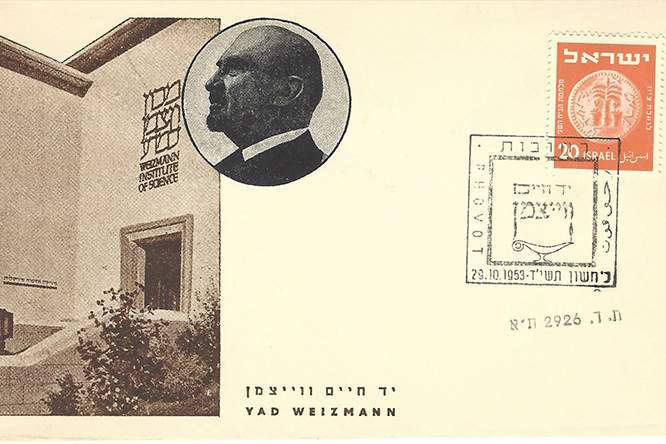
    Dr. Chaim Weizmann

    Chaim Weizmann was born in 1874 to a traditional Jewish family in the small town of Motol in White Russia (Belarus). After graduating with honors from the Real-Gymnasium in Pinsk, he decided to establish himself professionally

    More »
    Weizmann House
    • History and Architecture
    • The Collection
    • The Tour
    • The Garden
    • The Grave
    • Erich Mendelsohn
    • The Presidential Car Vintage Wheels

    Visiting the Institute


    • Visitors Center
    • Weizmann House
    • Clore Garden of Science
    |
    | | | | | |
    |
  • Weizmann Institute Homepage
Home » Press Room » Press Releases
News
  • Press Releases
    • English
    • Hebrew
    • Spanish
    • French
    • German
  • In the News
  • Subscribe to Press Releases
  • Honors and Awards
  • Visits
  • Events

twitter block


Tweets by @WeizmannScience

Aiming to the Side

04 Feb
2010
Neuroscience

Weizmann Institute research reveals that flying bats apply the laws of sonar physics to locate objects in the dark


EMBARGO:  Thursday, 4 February 2010, 2:00 pm U.S. Eastern Time

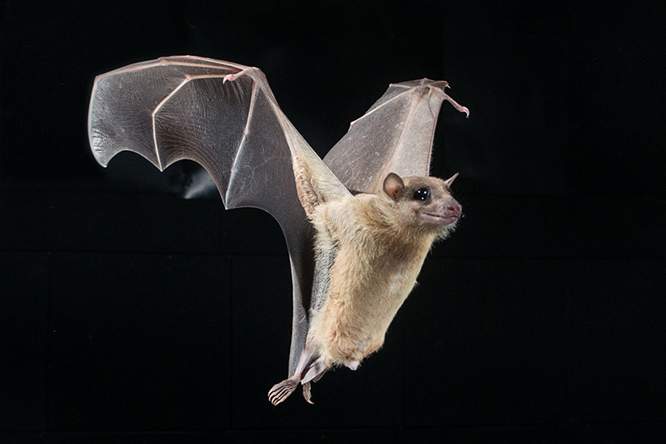
The best way to track a moving object with a flashlight might be to aim it to one side, catching the object in the edge of the beam rather than the center. New research at the Weizmann Institute of Science reveals that bats, which ‘see’ with beams of sound waves, skew their beams off-center when they want to locate an object. The research, which recently appeared in Science, shows that this strategy is the most efficient for locating objects.
 
Dr. Nachum Ulanovsky and postdoctoral fellow Dr. Yossi Yovel of the Institute’s Neurobiology Department knew that bat sonar (or echolocation) obeys the same physical laws as the sonar on a submarine: The bats (or ships) emit a sound and listen for the echo, accurately judging the type and location of objects around them by the changes in the sound waves as they’re reflected back. But there’s a trade-off between detection and localization. The beam is most intense in the center, returning more information, which is good for detection; but localization is better done on the slope, where the intensity drops off as the signal spreads out, making it easier to follow movement across the beam.

Are bats able to choose the best echolocation strategy? Ulanovsky and Yovel, in collaboration with Prof. Cynthia Moss and research student Ben Falk from the University of Maryland, trained bats to locate and land on a black sphere placed randomly in a completely dark room, using echolocation alone. A string of special microphones arrayed around the room’s walls traced the bats’ sound waves, while two infrared video cameras tracked their flight patterns.

The Egyptian fruit bats in Ulanovsky’s lab produce their signals in pairs of clicks. The researchers identified a pattern: The first set of double clicks was aimed left, and then right, and the next set right, then left. As the bats closed in for a landing, they continued to throw their sound beams to alternate sides of the sphere, just where a mathematical formula for sonar sensing predicted they would be most effective. As the sphere was easily detectable, the bat’s optimal strategy was one of localization. To test a situation in which detection was needed as well as localization, the scientists installed a large panel behind the sphere that echoed the sound waves back to the bats’ ears. Now they had to find the sphere’s echo amidst conflicting signals. This time, as the bats approached their target, they began to narrow their sweep and aim the beams more or less directly toward the sphere.


Many types of sensation, from echolocation in dolphins to sniffing in dogs to human eye movements, are based on some sort of active sensing. Ulanovsky and Yovel believe that what works for bats may well work for other animals: ‘sensing on the slope’ could play a role in all of these and others.
Dr. Nachum Ulanovsky's research is supported by the Nella and Leon Benoziyo Center for Neurological Diseases; the Carl and Micaela Einhorn-Dominic Brain Research Institute; the J&R Foundation; and the A.M.N. Fund for the Promotion of Science, Culture and Arts in Israel.


The Weizmann Institute of Science in Rehovot, Israel, is one of the world's top-ranking multidisciplinary research institutions. Noted for its wide-ranging exploration of the natural and exact sciences, the Institute is home to 2,600 scientists, students, technicians and supporting staff. Institute research efforts include the search for new ways of fighting disease and hunger, examining leading questions in mathematics and computer science, probing the physics of matter and the universe, creating novel materials and developing new strategies for protecting the environment.

Weizmann Institute news releases are posted on the World Wide Web at http://wis-wander.weizmann.ac.il/, and are also available at http://www.eurekalert.org/

Tags:
  • Bats,
  • Echolocation,
  • Nachum Ulanovsky,
  • Sensory stimulus,
  • Sonar ,
  • ""
  • Print this page »

Search Press Releases

Related Articles

Bat Memories
Fruit Bats Navigate with Internal Maps
What Makes a Grid?
Neural Activity in Bats Measured In Flight
More Related links »
A conversation between nerve cells in the brain
Edit block | Delete block

Edit block | Delete block

Download our FREE Interface Magazine App for iPad and Android

Secondary Links

  • Contact Us
  • Visit Us
  • How to Get Here
  • Campus Map
  • Site Map
  • Privacy
  • Terms of Use
  • Supporting Committees
  • Credits

Get RSS
© Weizmann Institute of Science 2012. All rights reserved
Follow us on:
[Jump to Top] [Jump to Main Content]