[[Skip Header and Navigation] [Jump to Main Content]
« עברית
  • Home
  • News
    • Press Releases
    • In the News
    • Subscribe to Press Releases
    • Honors and Awards
    • Visits
    • Events

    Press Releases

    16 May 2013
    Weather on the Outer Planets Only Goes So Deep
    18 Apr 2013
    Neural Activity in Bats Measured In Flight
    18 Mar 2013
    Programmed Destruction

    More »

    Research Highlights

    GeneCards
    Noncoding Sequences Get Equal Listing

    A greatly expanded database will give scientists around the world a powerful new tool for life sciences research

    gut cells
    The Spies Inside

    How does the immune system in the gut distinguish between helpful microbes and those that wish us harm?

    Ron Diskin
    Mutations Trump Invasion

    The process of HIV infection is just one the subjects protein researcher Dr. Ron Diskin is investigating in his new lab

    More »

    Honors & Awards

    Dr. Zohar Komargodski has been awarded the Gribov Medal by the EPS High Energy Particle Physics Division Prizes
    More »

    Full list »

    |
    | | | | | |
    |
  • Research
    • By Subject
    • What We Are Doing About:
    • From Basic Research to Benefiting Humanity
    • Shaping the Future

    By Subject

    Alternative Energy Materials Science
    Astrophysics Mathematics
    Biochemistry  Molecular Cell Biology
    Bioinformatics Nanoscience
    Biomedical Biology Neuroscience
    Cancer Particle Physics
    Chemistry Physics
    Computer Science Plant Sciences
    Environment Quantum Physics
    Evolution Scientific Archaeology
    Genetics Structural Biology

    What We Are Doing About:

    • Cancer
    • Diabetes
    • The Environment
    • Nanoscience
    • Energy

    Benefiting Humanity

    Prof. Amos Breskin
    Prof. Amos Breskin develops advanced radiation detectors, which have an important impact on many fields of research, such as particle, nuclear and atomic physics, medical diagnostics, biology and materials science.

     
    Application

    More »

    Full list »

    |
    | | | | | |
    |
  • Magazines and Multimedia
    • Annual Report
    • Interface - Online Magazine
    • The Weizmann International Magazine of Science and People
    • Books
    • Nano Comics
    • Galleries
    • Horizons - Online Magazine
    Annual Report 2011
    Art and Science on the Move
    Administering the Institute
    Research
    Financial Highlights
    Roll of Honor
    Supporting Network
    More »

    Magazines

    Current Issue: Spring 2013
    Interface magazine Spring 2013
    Magazine Sections
    Science Feature Articles
    Made at the Institute
    Time Tunnel

    Archive »

    Latest Videos

    CRASH
    The Race for the Higgs Boson
    • Monitoring Carbon Exchange
    • Thanks for the Memories
    • Quantum Computing
    • Back to Basics - Forward to the Future
    More »
    |
    | | | | | |
    |
  • About the Institute
    • Overview
    • History
    • Virtual Tour
    • Visiting the Institute

    Overview

    • Multidisciplinary Research
    • Facts and Figures
    • Pioneering Progress
    • Training Future Scientists
    • Science is for Sharing
    • Advancing Israel
    • New Horizons
    • Beauty in Science

    History

    Dr. Chaim Weizmann

    Chaim Weizmann was born in 1874 to a traditional Jewish family in the small town of Motol in White Russia (Belarus). After graduating with honors from the Real-Gymnasium in Pinsk, he decided to establish himself professionally

    More »
    Weizmann House
    • History and Architecture
    • The Collection
    • The Tour
    • The Garden
    • The Grave
    • Erich Mendelsohn
    • The Presidential Car Vintage Wheels

    Visiting the Institute


    • Visitors Center
    • Weizmann House
    • Clore Garden of Science
    |
    | | | | | |
    |
  • Weizmann Institute Homepage
Home » Press Room » Press Releases
News
  • Press Releases
    • English
    • Hebrew
    • Spanish
    • French
    • German
  • In the News
  • Subscribe to Press Releases
  • Honors and Awards
  • Visits
  • Events

twitter block


Follow @WeizmannScience

Defending Against Chemical Acts of Terrorism

19 Apr
2012
Biochemistry


Embargoed for release: 19-Apr-2012 12:00 ET
(19-Apr-2012 16:00 GMT)

 
Researchers may have found a way to protect us against otherwise deadly chemical attacks, such as the subway sarin incident in Tokyo that left thirteen people dead and thousands more injured or with temporary vision problems. The method is based on a new and improved version of a detoxifying enzyme produced naturally by our livers, according to the report in the April 2012 issue of Chemistry & Biology, a Cell Press publication.

"The sarin attack in Tokyo in 1995 demonstrated that both the raw materials and know-how of producing deadly nerve agents are available to people outside government or military institutions," said Moshe Goldsmith of the Weizmann Institute of Science in Israel. "We hope that our work would provide a prophylactic drug that will effectively protect the medical, police, and other teams that will have to act in a contaminated area following such an attack and would also provide these teams with a drug that could be administered on-site to intoxicated individuals to greatly improve their chances of survival."

Today, protection against nerve agents relies primarily on physical barriers such as gas masks and protective suits that can easily be breached, Goldsmith explained. Following exposure, people are treated with drugs that help with the symptoms but don't eliminate the nerve agent.

Goldsmith and the study's senior author Dan Tawfik hope to change this, relying on the principles of evolution to produce a more efficient version of an enzyme that occurs naturally in all of us. Known as paraoxonase 1 (PON1), this enzyme was originally named for its ability to assist in the breakdown of the insecticide paraoxon. It is also involved in drug metabolism and detoxification.

PON1 normally does counteract G-type nerve agents, including sarin, tabun, soman, and cyclosarin, but not well enough. Tawfik's lab specializes in a technique called "directed enzyme evolution, "in which they artificially introduce mutations into the gene encoding a target enzyme, in this case PON1. The mutated versions of the gene are then put back into bacteria, which produce the enzymes for testing.

The goal was to end up with enzymes capable of detoxifying G-type nerve agents before those nerve agents could reach their target and cause harm. Those that passed the initial test went on to further rounds of evolution and testing.

After four rounds of evolution, the researchers obtained PON1 variants that worked up to 340 times better than those produced previously. Overall, the researchers reported that the PON1 variants showed 40- to 3,400-fold higher efficiency than the normal enzyme in metabolizing the three most toxic G-type nerve agents.

These new and improved PON1 enzymes have become promising candidates for use as preventive and postexposure treatments in the event of a terrorist attack.

"We hope that our enzymes would be able to act together with currently available drugs to improve survival rates following intoxication," Goldsmith said. More broadly, the findings show the power of laboratory evolution to completely reshape existing enzymes for a variety of uses.
 
Goldsmith et al.: "Evolved stereoselective hydrolases for broad-spectrum G-type nerve agent detoxification."
 

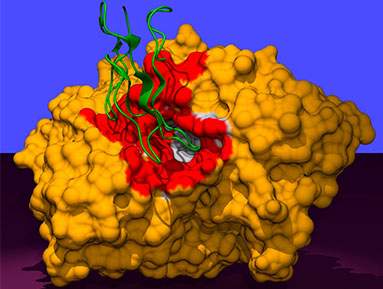
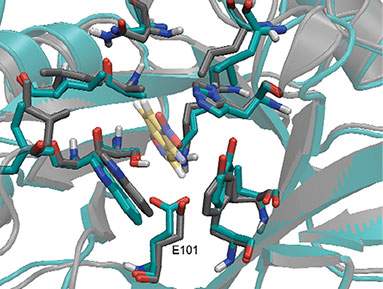
PON1
PON1 molecular structure. From the lab of Prof. Dan Tawfik


Prof. Dan Tawfik's research is supported by the estate of Mark Scher; Ms. Miel de Botton, UK; and the Sassoon and Marjorie Peress Philanthropic Fund. Prof. Tawfik is the incumbent of the Nella and Leon Benoziyo Professorial Chair.

Tags:
  • Biological Chemistry,
  • Dan Tawfik,
  • Nerve gas,
  • PON1,
  • Protein evolution,
  • ""
  • Print this page »

Search Press Releases

Related Articles

Protein 'Heroes' Block Genetic Mutations
1997 Teva Founders Prize To Weizmann Institute's Prof. David Wallach
Antibodies Know Right From Left
Therapeutic Effects of Garlic Clarified by Weizmann Institute Research
More Related links »
Crystals
Crystals
Edit block | Delete block

Edit block | Delete block

Download our FREE Interface Magazine App for iPad and Android

Secondary Links

  • Contact Us
  • Visit Us
  • How to Get Here
  • Campus Map
  • Site Map
  • Privacy
  • Terms of Use
  • Supporting Committees
  • Credits

Get RSS
© Weizmann Institute of Science 2012. All rights reserved
Follow us on:
[Jump to Top] [Jump to Main Content]