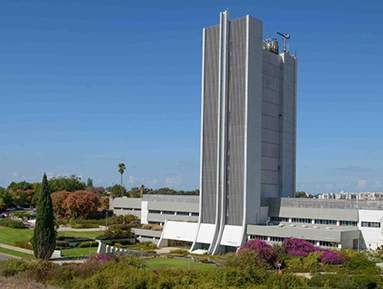
Koffler Accelerator of the Canada Centre of Nuclear Physics
Architect: Moshe Harel
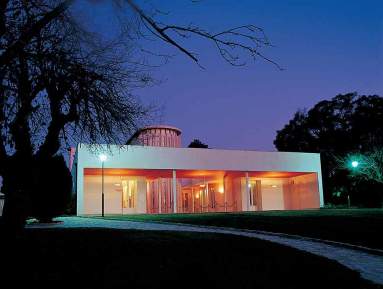
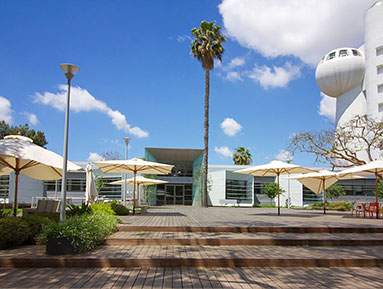
The Koffler Accelerator of the Canada Centre of Nuclear Physics, designed by the architect Moshe Harel in 1975, has become an architectural symbol of the Weizmann Institute of Science. This unique building combines two towers. One, shaped like a corkscrew, is 57 meters high; the other, 53 meters high, is topped by an egg-shaped structure 22 meters long and 14 meters across at its widest point.


This design belongs to a period influenced by the first achievements in space, by pop music and by the props of science fiction films (such as the futuristic but real home in which Woody Allen’s Sleeper was filmed in 1973). At the time, architectural groups and movements were searching for new ways of expression that would diverge from straightforward, “dry” Modernism. Most famous among these was the Archigram Group, which designed structures so futuristic and radical they were never built. These included transportable buildings with legs and a city whose parts could be removed or added. The accelerator at the Weizmann Institute of Science is clearly related to the Einstein Tower, a solar observatory in Potsdam, Germany, built in the early 1920s by Erich Mendelsohn, the famous architect whose name is inextricably linked with the Weizmann Institute.

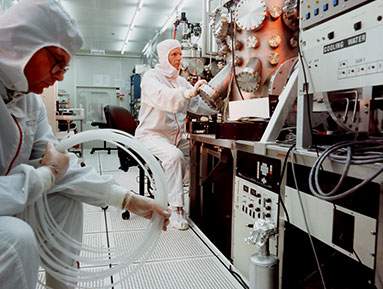
In the 1970s, the accelerator enabled Weizmann Institute scientists to work at the forefront of world science. With time, however, its experiments reached their completion, and recently it was decided to end its operation.

The Koffler building is made of exposed concrete cast under pressure in industrial steel beds, as evidenced by signs of holes in the concrete, and is painted white. One of the concrete towers looks like a mushroom stalk, bulging somewhat in the middle, atop which is the “egg.” The other, the “corkscrew,” is the service tower. The towers are connected by a joint ground-floor structure as well as by three bridges at different levels.
The monumental but simple geometry of the accelerator building is a striking example of Formalism in architecture, which can also be seen in such new buildings as the CCTV tower designed by Rem Koolhaas in Beijing and the “antenna towers” designed by Santiago Calatrava in various places around the world, including Berlin, Shanghai and Barcelona.