[[Skip Header and Navigation] [Jump to Main Content]
« עברית
  • Home
  • News
    • Press Releases
    • In the News
    • Subscribe to Press Releases
    • Honors and Awards
    • Visits
    • Events

    Press Releases

    16 May 2013
    Weather on the Outer Planets Only Goes So Deep
    18 Apr 2013
    Neural Activity in Bats Measured In Flight
    18 Mar 2013
    Causing Collapse

    More »

    Research Highlights

    GeneCards
    Noncoding Sequences Get Equal Listing

    A greatly expanded database will give scientists around the world a powerful new tool for life sciences research

    gut cells
    The Spies Inside

    How does the immune system in the gut distinguish between helpful microbes and those that wish us harm?

    Ron Diskin
    Mutations Trump Invasion

    The process of HIV infection is just one of the subjects protein researcher Dr. Ron Diskin is investigating in his new lab

    More »

    Honors & Awards

    Dr. Zohar Komargodski has been awarded the Gribov Medal by the EPS High Energy Particle Physics Division Prizes
    More »

    Full list »

    |
    | | | | | |
    |
  • Research
    • By Subject
    • What We Are Doing About:
    • From Basic Research to Benefiting Humanity
    • Shaping the Future

    By Subject

    Alternative Energy Materials Science
    Astrophysics Mathematics
    Biochemistry  Molecular Cell Biology
    Bioinformatics Nanoscience
    Biomedical Biology Neuroscience
    Cancer Particle Physics
    Chemistry Physics
    Computer Science Plant Sciences
    Environment Quantum Physics
    Evolution Scientific Archaeology
    Genetics Structural Biology

    What We Are Doing About:

    • Cancer
    • Diabetes
    • The Environment
    • Nanoscience
    • Energy

    Benefiting Humanity

    Prof. Amos Breskin
    Prof. Amos Breskin develops advanced radiation detectors, which have an important impact on many fields of research, such as particle, nuclear and atomic physics, medical diagnostics, biology and materials science.

     
    Application

    More »

    Full list »

    |
    | | | | | |
    |
  • Magazines and Multimedia
    • Annual Report
    • Interface - Online Magazine
    • The Weizmann International Magazine of Science and People
    • Books
    • Nano Comics
    • Galleries
    • Horizons - Online Magazine
    Annual Report 2012
    The 2012 Report
    Annual Report 2012
    2012 and Beyond
    Research Highlights
    New Developments
    Technology Transfer
    Summary of Operating Results
    More »

    Magazines

    Current Issue: Spring 2013
    Interface magazine Spring 2013
    Magazine Sections
    Science Feature Articles
    Made at the Institute
    Time Tunnel

    Archive »

    Latest Videos

    CRASH
    The Race for the Higgs Boson
    • Monitoring Carbon Exchange
    • Thanks for the Memories
    • Quantum Computing
    • Back to Basics - Forward to the Future
    More »
    |
    | | | | | |
    |
  • About the Institute
    • Overview
    • History
    • Virtual Tour
    • Visiting the Institute

    Overview

    • Multidisciplinary Research
    • Facts and Figures
    • Pioneering Progress
    • Training Future Scientists
    • Science is for Sharing
    • Advancing Israel
    • New Horizons
    • Beauty in Science

    History

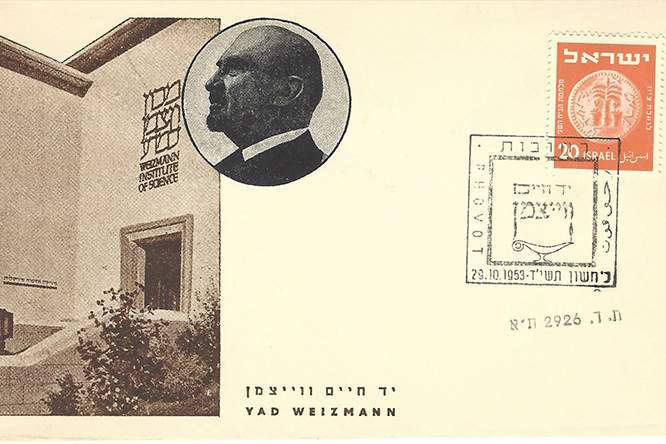
    Dr. Chaim Weizmann

    Chaim Weizmann was born in 1874 to a traditional Jewish family in the small town of Motol in White Russia (Belarus). After graduating with honors from the Real-Gymnasium in Pinsk, he decided to establish himself professionally

    More »
    Weizmann House
    • History and Architecture
    • The Collection
    • The Tour
    • The Garden
    • The Grave
    • Erich Mendelsohn
    • The Presidential Car Vintage Wheels

    Visiting the Institute


    • Visitors Center
    • Weizmann House
    • Clore Garden of Science
    |
    | | | | | |
    |
  • Weizmann Institute Homepage
Home » Press Room » Press Releases
News
  • Press Releases
    • English
    • Hebrew
    • Spanish
    • French
    • German
  • In the News
  • Subscribe to Press Releases
  • Honors and Awards
  • Visits
  • Events

twitter block


Follow @WeizmannScience

Lineage Trees Reveal Cells’ Histories

23 Feb
2012
Bioinformatics
Embargoed until 23rd February at 2pm Pacific time/5pm Eastern time/10pm GMT

In recent years, a number of controversial claims have been made about the female mammal’s egg supply – that it is renewed over her adult lifetime (as opposed to the conventional understanding that she is born with all of her eggs), and that the source of these eggs is stem cells that originate in the bone marrow. Now, Weizmann Institute scientists have disproved one of those claims and pointed in new directions toward resolving the other. Their findings, based on an original method for reconstructing lineage trees for cells, were published online today in PLoS Genetics.

The method, developed over several years in the lab of Prof. Ehud Shapiro of the Institute’s Biological Chemistry, and Computer Science and Applied Mathematics Departments, uses mutations in specific genetic markers to determine which cells are most closely related and how far back they share a common parent cell, to create a sort of family tree for cells. Shapiro and members of his lab, including Drs. Shalev Itzkovitz and Rivka Adar, together with Prof. Nava Dekel and research student Yitzhak Reizel of the Biological Regulation Department, used their method to see if ova could be descended from bone-marrow stem cells. Their findings indicated that any relationship between the two types was too distant for one to be an ancestor of the other.

These scientists also found, surprisingly, that the ova of older mice had undergone more cell divisions than those of younger mice. This could be the result of replenishment during adulthood, but an alternate theory holds that all eggs are created before birth, and those that undergo fewer divisions are simply selected earlier on for ovulation. Further experimentation, says Shapiro, will resolve the issue.
Cell lineage trees are similar to modern evolutionary and taxonomic trees based on genome comparisons between organisms. Shapiro and his team used mutations in cells that are passed on to daughter cells over an organism’s lifetime (though not on to the next generation). By comparing a number of genetic sequences called microsatellites – areas where mutations occur like clockwork – they can place cells on trees to reveal their developmental history.

A number of papers published by Shapiro, his team and collaborators in recent months have demonstrated the power and versatility of this method. One study, for instance, lent support to the notion that the adult stem cells residing in tiny crypts in the lining of the colon do not harbor, as thought, “immortal DNA strands.” Immortal strands may be retained by dividing stem cells if they always relegate the newly-synthesized DNA to the differentiating daughter cell and keep the original strand in the one that remains a stem cell.

A second study addressed an open question about developing muscle cells. Here they found that two kinds of progenitor cell – myogenic cells, which eventually give rise to muscle fiber, and non-myogenic cells – found within the same muscle, are more closely related than similar cells in different muscles.

One immediate advantage of the cell lineage analysis method developed by Shapiro’s team is that it is non-invasive and retrospective, and as such can be applied to the study of human cell lineages. Most other studies of development rely on genetically engineered lab animals in which the stem cells are tagged with fluorescent markers. In addition to providing a powerful new research method that does not rely on such markers, Shapiro believes that it could one day be adapted as a diagnostic tool that might, for instance, reveal the history of an individual’s cancer and help doctors determine the best course of treatment.

Also participating in this research were Noa Chapla-Ilani, Adrian Jinich and Drs. Elad Segev, Eran Segal and Yosef Maruvka of the Computer Science and Applied Mathematics Department; Zipora Marx, Inna Horovitz and Adam Wasserstrom of the Biological Chemistry Department; Drs. Judith Elbaz and Nava Nevo of the Biological Regulation Department; Dr. Avi Mayo of the Molecular Cell Biology Department; Drs. Gabi Shefer, Irena Shur and Prof. Dafna Benayahu of Tel Aviv University; and Prof. Karl Skorecki of the Technion and Rambam Medical Center, Haifa.
 
 
mouse cell lineages
Mouse cell lineage tree. Oocytes are in red, bone marrow stem cells in yellow, demonstrating that the two form separate clusters with only a distant relationship


Prof. Ehud Shapiro’’s research is supported by the Paul Sparr Foundation; Miel de Botton Aynsley, UK; the Carolito Stiftung; and the European Research Council. Prof. Shapiro is the incumbent of the Harry Weinrebe Professorial Chair of Computer Science and Biology.

Prof. Nava Dekel’s research is supported by the Phyllis and Joseph Gurwin Fund for Scientific Advancement; the Jeanne and Joseph Nissim Foundation for Life Sciences Research; the M.D. Moross Institute for Cancer Research; the Y. Leon Benoziyo Institute for Molecular Medicine; the Yeda-Sela Center for Basic Research; the Willner Family Center for Vascular Biology, which she heads; the Dwek Family Biomedical Research Fund; the J&R Foundation; La Fondation Raphael et Regina Levy; the estate of John Hunter; and Allyson Kaye, UK. Prof. Dekel is the incumbent of the Philip M. Klutznick Professorial Chair of Developmental Biology.

Dr. Eran Segal’s research is supported by the Cecil and Hilda Lewis Charitable Trust; the Carolito Stiftung; the Kahn Family Research Center for Systems Biology of the Human Cell; and the European Research Council.  

Tags:
  • Biological Chemistry,
  • Biological Regulation,
  • Cell lineage,
  • Computer Science and Applied Mathematics,
  • Ehud Shapiro,
  • Nava Dekel,
  • Stem cell,
  • ""
  • Print this page »

Search Press Releases

Related Articles

Protein 'Heroes' Block Genetic Mutations
1997 Teva Founders Prize To Weizmann Institute's Prof. David Wallach
Antibodies Know Right From Left
Therapeutic Effects of Garlic Clarified by Weizmann Institute Research
More Related links »

Edit block | Delete block

Download our FREE Interface Magazine App for iPad and Android

Secondary Links

  • Contact Us
  • Visit Us
  • How to Get Here
  • Campus Map
  • Site Map
  • Privacy
  • Terms of Use
  • Supporting Committees
  • Credits

Get RSS
© Weizmann Institute of Science 2012. All rights reserved
Follow us on:
[Jump to Top] [Jump to Main Content]