[[Skip Header and Navigation] [Jump to Main Content]
« עברית
  • Home
  • News
    • Press Releases
    • In the News
    • Subscribe to Press Releases
    • Honors and Awards
    • Visits
    • Events

    Press Releases

    16 May 2013
    Weather on the Outer Planets Only Goes So Deep
    18 Apr 2013
    Neural Activity in Bats Measured In Flight
    18 Mar 2013
    Programmed Destruction

    More »

    Research Highlights

    GeneCards
    Noncoding Sequences Get Equal Listing

    A greatly expanded database will give scientists around the world a powerful new tool for life sciences research

    gut cells
    The Spies Inside

    How does the immune system in the gut distinguish between helpful microbes and those that wish us harm?

    Ron Diskin
    Mutations Trump Invasion

    The process of HIV infection is just one of the subjects protein researcher Dr. Ron Diskin is investigating in his new lab

    More »

    Honors & Awards

    Dr. Zohar Komargodski has been awarded the Gribov Medal by the EPS High Energy Particle Physics Division Prizes
    More »

    Full list »

    |
    | | | | | |
    |
  • Research
    • By Subject
    • What We Are Doing About:
    • From Basic Research to Benefiting Humanity
    • Shaping the Future

    By Subject

    Alternative Energy Materials Science
    Astrophysics Mathematics
    Biochemistry  Molecular Cell Biology
    Bioinformatics Nanoscience
    Biomedical Biology Neuroscience
    Cancer Particle Physics
    Chemistry Physics
    Computer Science Plant Sciences
    Environment Quantum Physics
    Evolution Scientific Archaeology
    Genetics Structural Biology

    What We Are Doing About:

    • Cancer
    • Diabetes
    • The Environment
    • Nanoscience
    • Energy

    Benefiting Humanity

    Prof. Amos Breskin
    Prof. Amos Breskin develops advanced radiation detectors, which have an important impact on many fields of research, such as particle, nuclear and atomic physics, medical diagnostics, biology and materials science.

     
    Application

    More »

    Full list »

    |
    | | | | | |
    |
  • Magazines and Multimedia
    • Annual Report
    • Interface - Online Magazine
    • The Weizmann International Magazine of Science and People
    • Books
    • Nano Comics
    • Galleries
    • Horizons - Online Magazine
    Annual Report 2012
    The 2012 Report
    Annual Report 2012
    2012 and Beyond
    Research Highlights
    New Developments
    Technology Transfer
    Summary of Operating Results
    More »

    Magazines

    Current Issue: Spring 2013
    Interface magazine Spring 2013
    Magazine Sections
    Science Feature Articles
    Made at the Institute
    Time Tunnel

    Archive »

    Latest Videos

    CRASH
    The Race for the Higgs Boson
    • Monitoring Carbon Exchange
    • Thanks for the Memories
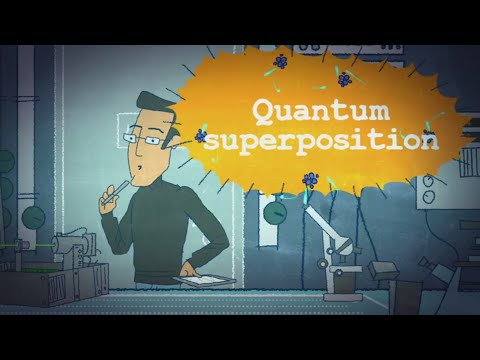
    • Quantum Computing
    • Back to Basics - Forward to the Future
    More »
    |
    | | | | | |
    |
  • About the Institute
    • Overview
    • History
    • Virtual Tour
    • Visiting the Institute

    Overview

    • Multidisciplinary Research
    • Facts and Figures
    • Pioneering Progress
    • Training Future Scientists
    • Science is for Sharing
    • Advancing Israel
    • New Horizons
    • Beauty in Science

    History

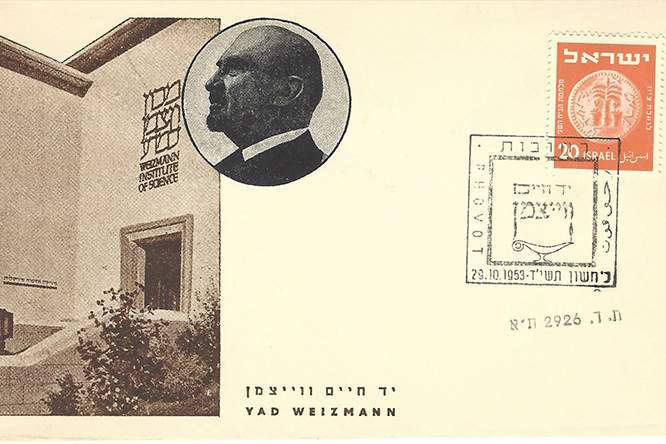
    Dr. Chaim Weizmann

    Chaim Weizmann was born in 1874 to a traditional Jewish family in the small town of Motol in White Russia (Belarus). After graduating with honors from the Real-Gymnasium in Pinsk, he decided to establish himself professionally

    More »
    Weizmann House
    • History and Architecture
    • The Collection
    • The Tour
    • The Garden
    • The Grave
    • Erich Mendelsohn
    • The Presidential Car Vintage Wheels

    Visiting the Institute


    • Visitors Center
    • Weizmann House
    • Clore Garden of Science
    |
    | | | | | |
    |
  • Weizmann Institute Homepage
Home » Press Room » Press Releases
News
  • Press Releases
    • English
    • Hebrew
    • Spanish
    • French
    • German
  • In the News
  • Subscribe to Press Releases
  • Honors and Awards
  • Visits
  • Events

twitter block


Follow @WeizmannScience

Listening with One Atom

25 May
2011
Quantum Physics
Weizmann Institute scientists set a new record for measuring magnetic vibrations using the spin of a single atom: 100 times more accurate than the previous record
 
The lab, though it may seem quiet and insulated, can be as full of background noise as a crowded train station when we’re trying to catch the announcements. Our brains can filter out the noise and focus on the message up to a certain point, but turning up the volume on the loudspeakers – improving the signal-to-noise ratio – helps as well.
 
Separating out the signal from the noise – increasing one while reducing the other – is so basic that much of scientific research could not take place without it. One common method, developed by the physicist Robert Dicke at Princeton University, is based on a principle similar to the one that enables radio broadcasts to pass through the noisy atmosphere. In short, one modulates electric waves (which correspond to the sound waves) one wishes to send over long distances, adding them on top of a high-frequency wave. To listen to the broadcast, one must have a receiver that is tuned to the frequency of the carrier wave (that numbered band on the FM dial), which then splits the two waves apart and amplifies the second “rider” wave – the music or talk we want to hear.
 
The method used by the physics labs is called “locked-in amplification.” Here, too, a low-frequency, measured signal “rides” a high-frequency wave. A locked-in amplifier singles out the specific wave from the rest of the noise, “locking” onto the required signal and enabling scientists to make all sorts of accurate measurements.
 
To obtain good spatial resolution, one should measure with the smallest possible detector; one can’t get much smaller than a single atom. The world of single atoms, however, is governed by the laws of quantum physics, and any sort of observation in the quantum world is a complex undertaking. The Heisenberg uncertainty principle, one of the cornerstones of quantum theory, sets limits on our ability to measure with any kind of precision. But that very theory contains some clues as to how these limits can be approached.
 
Dr. Roee Ozeri and research students Shlomi Kotler, Nitzan Akerman, Yinnon Glickman and Anna Keselman in the Weizmann Institute’s Physics of Complex Systems Department applied the rules of quantum mechanics to a single atomic-ion detector, building a quantum version of a locked-in amplifier. Using the ions’ spin as a sensor, they were able to measure magnetic vibrations with a spatial resolution of a just few nanometers (a few billionths of a meter). The sensitivity of this measurement was extremely high: around 100 times better than any previous such measurement. This technique, says Ozeri, could be used in physics labs around the world to improve the sensitivity of all sorts of quantum sensors.
 
 
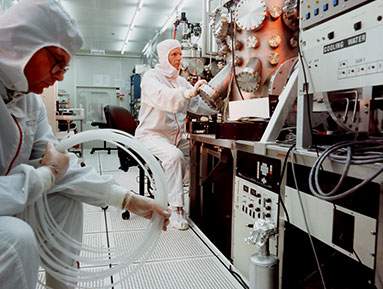
Ion trap in the lab of Dr. Roee OzeriIon trap in the lab of Dr. Roee Ozeri
 

Dr. Roee Ozeri’s research is supported by the Yeda-Sela Center for Basic Research; the Wolfson Family Charitable Trust; David Dickstein, France; and Martin Kushner Schnur, Mexico. 

Tags:
  • Electron,
  • Ion trap,
  • Physics of Complex Systems,
  • Quantum physics,
  • Roee Ozeri,
  • ""
  • Print this page »

Search Press Releases

Related Articles

More Bytes for the Buck
Fire on the Move
Clusters, Computers and the Human Brain
Weizmann Institute Scientists Develop a Novel System for Analyzing Genetic Data that Mimics the Human Capacity for Unsupervised Learning
More Related links »
Atomic ions trapped in a quantum state
Edit block | Delete block

Edit block | Delete block

Download our FREE Interface Magazine App for iPad and Android

Secondary Links

  • Contact Us
  • Visit Us
  • How to Get Here
  • Campus Map
  • Site Map
  • Privacy
  • Terms of Use
  • Supporting Committees
  • Credits

Get RSS
© Weizmann Institute of Science 2012. All rights reserved
Follow us on:
[Jump to Top] [Jump to Main Content]