[[Skip Header and Navigation] [Jump to Main Content]
« עברית
  • Home
  • News
    • Press Releases
    • In the News
    • Subscribe to Press Releases
    • Honors and Awards
    • Visits
    • Events

    Press Releases

    16 May 2013
    Weather on the Outer Planets Only Goes So Deep
    18 Apr 2013
    Neural Activity in Bats Measured In Flight
    18 Mar 2013
    Programmed Destruction

    More »

    Research Highlights

    GeneCards
    Noncoding Sequences Get Equal Listing

    A greatly expanded database will give scientists around the world a powerful new tool for life sciences research

    gut cells
    The Spies Inside

    How does the immune system in the gut distinguish between helpful microbes and those that wish us harm?

    Ron Diskin
    Mutations Trump Invasion

    The process of HIV infection is just one of the subjects protein researcher Dr. Ron Diskin is investigating in his new lab

    More »

    Honors & Awards

    Dr. Zohar Komargodski has been awarded the Gribov Medal by the EPS High Energy Particle Physics Division Prizes
    More »

    Full list »

    |
    | | | | | |
    |
  • Research
    • By Subject
    • What We Are Doing About:
    • From Basic Research to Benefiting Humanity
    • Shaping the Future

    By Subject

    Alternative Energy Materials Science
    Astrophysics Mathematics
    Biochemistry  Molecular Cell Biology
    Bioinformatics Nanoscience
    Biomedical Biology Neuroscience
    Cancer Particle Physics
    Chemistry Physics
    Computer Science Plant Sciences
    Environment Quantum Physics
    Evolution Scientific Archaeology
    Genetics Structural Biology

    What We Are Doing About:

    • Cancer
    • Diabetes
    • The Environment
    • Nanoscience
    • Energy

    Benefiting Humanity

    Prof. Amos Breskin
    Prof. Amos Breskin develops advanced radiation detectors, which have an important impact on many fields of research, such as particle, nuclear and atomic physics, medical diagnostics, biology and materials science.

     
    Application

    More »

    Full list »

    |
    | | | | | |
    |
  • Magazines and Multimedia
    • Annual Report
    • Interface - Online Magazine
    • The Weizmann International Magazine of Science and People
    • Books
    • Nano Comics
    • Galleries
    • Horizons - Online Magazine
    Annual Report 2012
    The 2012 Report
    Annual Report 2012
    2012 and Beyond
    Research Highlights
    New Developments
    Technology Transfer
    Summary of Operating Results
    More »

    Magazines

    Current Issue: Spring 2013
    Interface magazine Spring 2013
    Magazine Sections
    Science Feature Articles
    Made at the Institute
    Time Tunnel

    Archive »

    Latest Videos

    CRASH
    The Race for the Higgs Boson
    • Monitoring Carbon Exchange
    • Thanks for the Memories
    • Quantum Computing
    • Back to Basics - Forward to the Future
    More »
    |
    | | | | | |
    |
  • About the Institute
    • Overview
    • History
    • Virtual Tour
    • Visiting the Institute

    Overview

    • Multidisciplinary Research
    • Facts and Figures
    • Pioneering Progress
    • Training Future Scientists
    • Science is for Sharing
    • Advancing Israel
    • New Horizons
    • Beauty in Science

    History

    Dr. Chaim Weizmann

    Chaim Weizmann was born in 1874 to a traditional Jewish family in the small town of Motol in White Russia (Belarus). After graduating with honors from the Real-Gymnasium in Pinsk, he decided to establish himself professionally

    More »
    Weizmann House
    • History and Architecture
    • The Collection
    • The Tour
    • The Garden
    • The Grave
    • Erich Mendelsohn
    • The Presidential Car Vintage Wheels

    Visiting the Institute


    • Visitors Center
    • Weizmann House
    • Clore Garden of Science
    |
    | | | | | |
    |
  • Weizmann Institute Homepage
Home » Press Room » Press Releases
News
  • Press Releases
    • English
    • Hebrew
    • Spanish
    • French
    • German
  • In the News
  • Subscribe to Press Releases
  • Honors and Awards
  • Visits
  • Events

twitter block


Follow @WeizmannScience

Living Microprocessor Tunes in to Feedback

12 Jun
2012
Genetics

What keeps the machinery for chopping functional pieces out of certain long RNA strands from cutting up the wrong kinds of RNA?

 
MicroRNAs (miRNAs) – tiny strands of non-protein-coding RNAs – start off as long strands of precursor miRNAs. These long strands get chopped up by a special kind of machinery, the “Microprocessor” complex, to transform them into their shorter functional form. The resulting miRNAs bind to messenger RNA (mRNAs) molecules, inhibiting their protein production capacity and thus regulating the levels of hundreds of different proteins.

But the Microprocessor complex can also cut up other forms of RNA, such as mRNAs, which sometimes generate a transient structure that resembles the target site of miRNAs. Cleaving the wrong RNAs could prove disastrous for the organism.

In a paper recently published in Nature Structural and Molecular Biology, Dr. Eran Hornstein, Prof. Naama Barkai and former Ph.D. students Drs. Omer Barad and Mati Mann of the Molecular Genetics Department focus on understanding how the Microprocessor machinery balances the interplay between efficiency and specificity in the production of miRNAs. “On the one hand, it should not be overly efficient, as this may come at the cost of also cleaving unwanted nonspecific RNA substrates. On the other hand, it should not be too ‘picky’ because exaggerated specificity comes with the risk of not sufficiently processing genuine miRNAs,” says Hornstein.

In an interdisciplinary project, the scientists used mathematical modeling to characterize the Microprocessor system and then tested their theories in cells. They predicted that the balance between efficiency and specificity would be maintained via a feedback loop in which the Microprocessor detects the amount of precursor miRNA available in the cell and alters its own production accordingly.

Checking this premise in mouse and human tissue, the researchers were able to show that the Microprocessor is indeed attuned to levels of precursor miRNA, upping its own production if the cell is inundated with precursor miRNA, or halting production in response to a decrease in the flow of precursors. This is achieved by the digestion of Dgcr8 mRNA, which structurally mimics miRNA. By keeping levels in line with precursor miRNAs, the Microprocessor thus reduces its chances of chopping off-target RNAs.

Since small RNAs are produced synthetically as possible new therapies for a number of diseases, this research may direct efforts to efficiently produce such therapies in the future. In addition, many other biological systems need to balance efficiency with specificity, and the team’s findings suggest that many may do so in a similar way.
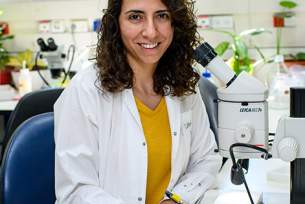

 
Dr. Eran Hornstein’s research is supported by Dr. Sidney Brenner and Friends; the Carolito Stiftung; the Nella and Leon Benoziyo Center for Neurological Diseases; the Y. Leon Benoziyo Institute for Molecular Medicine; the Nathan, Shirley, Philip and Charlene Vener New Scientist Fund; the estate of Fannie Sherr; the estate of Lola Asseof; Maria Halphen, France; the Julius and Ray Charlestein Foundation; the Legacy Heritage Fund; the Kekst Family Institute for Medical Genetics; the David and Fela Shapell Family Center for Genetic Disorders Research; the Helen and Martin Kimmel Institute for Stem Cell Research; the Crown Human Genome Center; the Celia Benattar Memorial Fund for Juvenile Diabetes; the Fraida Foundation; and the Wolfson Family Charitable Trust. Dr. Hornstein is the incumbent of the Helen and Milton A. Kimmelman Career Development Chair.

Prof. Naama Barkai’s research is supported by the Helen and Martin Kimmel Award for Innovative Investigation; the Jeanne and Joseph Nissim Foundation for Life Sciences Research; Lorna Greenberg Scherzer, Canada; the Carolito Stiftung; the European Research Council; the estate of Hilda Jacoby-Schaerf; and the estate of John Hunter. Prof. Barkai is the incumbent of the Lorna Greenberg Scherzer Professorial Chair.

Tags:
  • Eran Hornstein,
  • Mathematical model,
  • Molecular Genetics,
  • Naama Barkai,
  • RNA,
  • ""
  • Print this page »

Search Press Releases

Related Articles

Running Interference
Ancient Throwback: New Technology
Outside the Fold
Bonds
More Related links »
Bacterium organizing its genetic material into a liquid crystal
Edit block | Delete block

Edit block | Delete block

Download our FREE Interface Magazine App for iPad and Android

Secondary Links

  • Contact Us
  • Visit Us
  • How to Get Here
  • Campus Map
  • Site Map
  • Privacy
  • Terms of Use
  • Supporting Committees
  • Credits

Get RSS
© Weizmann Institute of Science 2012. All rights reserved
Follow us on:
[Jump to Top] [Jump to Main Content]