[[Skip Header and Navigation] [Jump to Main Content]
« עברית
  • Home
  • News
    • Press Releases
    • In the News
    • Subscribe to Press Releases
    • Honors and Awards
    • Visits
    • Events

    Press Releases

    16 May 2013
    Weather on the Outer Planets Only Goes So Deep
    18 Apr 2013
    Neural Activity in Bats Measured In Flight
    18 Mar 2013
    Cell on a Chip Reveals Protein Behavior

    More »

    Research Highlights

    GeneCards
    Noncoding Sequences Get Equal Listing

    A greatly expanded database will give scientists around the world a powerful new tool for life sciences research

    gut cells
    The Spies Inside

    How does the immune system in the gut distinguish between helpful microbes and those that wish us harm?

    Ron Diskin
    Mutations Trump Invasion

    The process of HIV infection is just one of the subjects protein researcher Dr. Ron Diskin is investigating in his new lab

    More »

    Honors & Awards

    Dr. Zohar Komargodski has been awarded the Gribov Medal by the EPS High Energy Particle Physics Division Prizes
    More »

    Full list »

    |
    | | | | | |
    |
  • Research
    • By Subject
    • What We Are Doing About:
    • From Basic Research to Benefiting Humanity
    • Shaping the Future

    By Subject

    Alternative Energy Materials Science
    Astrophysics Mathematics
    Biochemistry  Molecular Cell Biology
    Bioinformatics Nanoscience
    Biomedical Biology Neuroscience
    Cancer Particle Physics
    Chemistry Physics
    Computer Science Plant Sciences
    Environment Quantum Physics
    Evolution Scientific Archaeology
    Genetics Structural Biology

    What We Are Doing About:

    • Cancer
    • Diabetes
    • The Environment
    • Nanoscience
    • Energy

    Benefiting Humanity

    Prof. Amos Breskin
    Prof. Amos Breskin develops advanced radiation detectors, which have an important impact on many fields of research, such as particle, nuclear and atomic physics, medical diagnostics, biology and materials science.

     
    Application

    More »

    Full list »

    |
    | | | | | |
    |
  • Magazines and Multimedia
    • Annual Report
    • Interface - Online Magazine
    • The Weizmann International Magazine of Science and People
    • Books
    • Nano Comics
    • Galleries
    • Horizons - Online Magazine
    Annual Report 2012
    The 2012 Report
    Annual Report 2012
    2012 and Beyond
    Research Highlights
    New Developments
    Technology Transfer
    Summary of Operating Results
    More »

    Magazines

    Current Issue: Spring 2013
    Interface magazine Spring 2013
    Magazine Sections
    Science Feature Articles
    Made at the Institute
    Time Tunnel

    Archive »

    Latest Videos

    CRASH
    The Race for the Higgs Boson
    • Monitoring Carbon Exchange
    • Thanks for the Memories
    • Quantum Computing
    • Back to Basics - Forward to the Future
    More »
    |
    | | | | | |
    |
  • About the Institute
    • Overview
    • History
    • Virtual Tour
    • Visiting the Institute

    Overview

    • Multidisciplinary Research
    • Facts and Figures
    • Pioneering Progress
    • Training Future Scientists
    • Science is for Sharing
    • Advancing Israel
    • New Horizons
    • Beauty in Science

    History

    Dr. Chaim Weizmann
    Chaim Weizmann was born in 1874 to a traditional Jewish family in the small town of Motol in White Russia (Belarus). After graduating with honors from the Real-Gymnasium in Pinsk, he decided to establish himself professionally

    More »
    Weizmann House
    • History and Architecture
    • The Collection
    • The Tour
    • The Garden
    • The Grave
    • Erich Mendelsohn
    • The Presidential Car Vintage Wheels

    Visiting the Institute


    • Visitors Center
    • Weizmann House
    • Clore Garden of Science
    |
    | | | | | |
    |
  • Weizmann Institute Homepage
Home » Press Room » Press Releases
News
  • Press Releases
    • English
    • Hebrew
    • Spanish
    • French
    • German
  • In the News
  • Subscribe to Press Releases
  • Honors and Awards
  • Visits
  • Events

twitter block


Follow @WeizmannScience

Rejecting Arsenate

22 Oct
2012
Biochemistry

Institute scientists reveal how bacteria living in toxic environments identify and expel the poison

 
Not long ago, some unassuming bacteria found themselves at the center of a scientific controversy: A group claimed that these microorganisms, which live in an environment that is rich in the arsenic-based compound arsenate, could take up that arsenate and use it – instead of the phosphate on which all known life on Earth depends. The claim, since disproved, raised another question: How do organisms living with arsenate pick and choose the right substance?

Chemically, arsenate is nearly indistinguishable from phosphate. Prof. Dan Tawfik of the Biological Chemistry Department says: “Phosphate forms highly stable bonds in DNA and other key biological compounds, while bonds to arsenate are quickly broken. But how does a microorganism surrounded by arsenate distinguish between two molecules that are almost the same size and have identical shapes and ionic properties?”
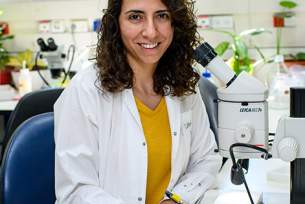
 
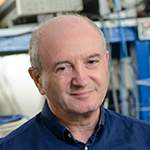
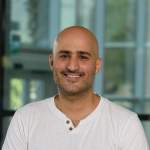
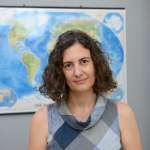
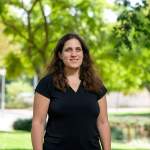
To investigate, Tawfik, postdoctoral fellow Dr. Mikael Elias, Ph.D. student Alon Wellner and lab assistant Korina Goldin, in collaboration with Tobias Erb and Julia Vorholt of ETH Zurich, looked at a protein in bacteria that takes up phosphate. This protein, called PBP (short for phosphate binding protein), sits near the bacteria’s outer membrane, where it latches onto phosphates and passes them on to pumps that transport them into the cell.

In research that recently appeared in Nature, the team compared the activity of several different PBPs – some from bacteria like E. coli that are sensitive to arsenate and others, like those from the arsenic-rich environment, which are tolerant of the chemical. While the PBPs in the ordinary bacterium were about 500 times more likely to bind phosphate over arsenate, in the arsenic-tolerant bacterium that factor jumped to around 5000. In other words, to cope with their toxic environment, the bacteria evolved a mechanism of extreme selectivity to ensure their supply of phosphate while keeping the arsenate out.

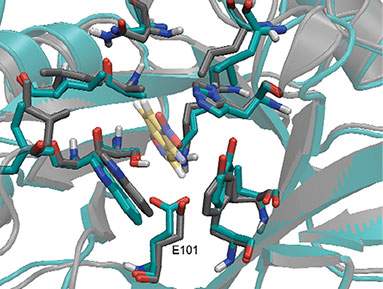
Elias then compared phosphate and arsenate binding by crystallizing PBPs along with one of the two compounds. But the initial comparison suggested that when arsenate bound to the protein, it did so in just the same way as phosphate. Elias suspected that the key might lie in a single, highly unusual bond between a hydrogen atom in the protein and the molecule. This bond had been previously noted but ignored, as phosphate binding occurred with or without it.

To see the difference, the team had to stretch the limits of crystallization technology, getting the resolution to less than one angstrom – fine enough to identify individual hydrogen atoms and compare their bonds. Only then were they able to identify a single disparity: The angles of that unusual hydrogen bond were different. Inside a tight cavity within the PBP structure, phosphate binds at a “textbook angle,” according to Elias. The slightly larger arsenate molecule, on the other hand, gets pushed up against the hydrogen and bonds at unnatural, distorted angles. Tawfik thinks that the angle is likely to lead to repulsion between the molecule and other atoms in the cavity, preventing the PBP from passing arsenate into the cell’s interior.

Tawfik: “These findings may go beyond the solving of a biological mystery. Because phosphates are scarce in many environments, there is quite a bit of interest in understanding how this crucial resource is taken up by organisms. This first observation of a PBP discrimination mechanism is an exciting demonstration of the exquisite fine tuning that enables proteins to distinguish between two nearly-identical molecules.”
 
Prof. Dan Tawfik’s research is supported by the Adelis Foundation; the estate of Mark Scher; and Ms. Miel de Botton, UK. Prof. Tawfik is the incumbent of the Nella and Leon Benoziyo Professorial Chair.

Tags:
  • Bacterial cells,
  • Biological Chemistry,
  • Dan Tawfik,
  • Protein,
  • X-ray crystallography,
  • ""
  • Print this page »

Search Press Releases

Related Articles

Study Shows How Ancient Chinese Herb May Act As Alzheimer Drug
Weizmann Institute Scientists Capture The First-Ever 3D Visualization Of How Molecules Break Apart When Exposed To X-Rays
Weizmann Institute Scientists Solve the 3-D Structure of the Enzyme Involved in Gaucher Disease
X-Rays May Show The Way To Better Alzheimer's Drugs
More Related links »
Crystals
Crystals
Edit block | Delete block

Edit block | Delete block

Download our FREE Interface Magazine App for iPad and Android

Secondary Links

  • Contact Us
  • Visit Us
  • How to Get Here
  • Campus Map
  • Site Map
  • Privacy
  • Terms of Use
  • Supporting Committees
  • Credits

Get RSS
© Weizmann Institute of Science 2012. All rights reserved
Follow us on:
[Jump to Top] [Jump to Main Content]