The Sidney Musher Building for Science Teaching
Architect: Gershon Zippor
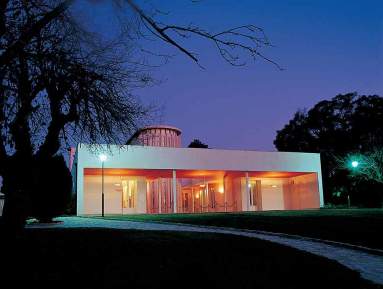
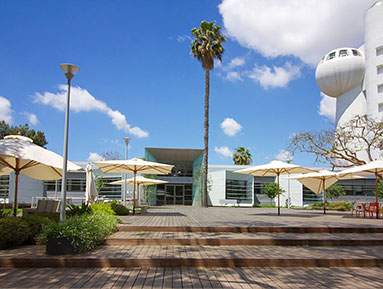
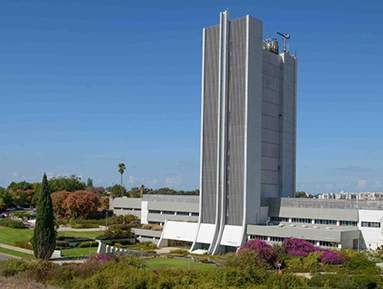
The Sidney Musher Building for Science Teaching was designed by the architect Gershon Zippor in 1990. Erected where a pine grove once stood, the building’s presence was minimized by being designed as a glass box growing out of the surrounding lawn and vegetation, which are reflected in its mirror walls. The emergence of this style, eventually to be known as Glass Architecture, can be traced back to the glass-and-steel structures that began to appear already in the midnineteenth century, with the development of iron and steel construction technologies. A hundred years later, glass was already being incorporated into the walls of private houses built – as is the Musher Building – in the heart of green groves. Today there is hardly a modern building without a glass front.

Even if not transparent, the walls of the Musher Building are nevertheless made of glass, set in matching anodized aluminum frames of a yellowish color, characteristic of the period. The dark-shaded glass not only conceals what is happening indoors; it also hides the divisions and levels of the building. The interior design includes a gray-linoleum-lined central corridor with rooms on either side, where windows open inward. While the corridor’s ceiling is low, concealing airconditioning pipes and other equipment, the offices have high ceilings, whose Spancrete precast hollow concrete panels are in plain view.
The entrances to the building, accentuated by striking yellow and red paint, stand out from the simple black glass box. At the main entrance, a yellow metal pyramid directs visitors to the Department of Science Teaching and to the side entrance of the Feinberg Graduate School. Red paint covers the aluminum jamb of the entrance door and the round column in the “missing” corner on the ground floor of the building, which creates a roofed entrance space and breaks up the perfect box.