[[Skip Header and Navigation] [Jump to Main Content]
« עברית
  • Home
  • News
    • Press Releases
    • In the News
    • Subscribe to Press Releases
    • Honors and Awards
    • Visits
    • Events

    Press Releases

    16 May 2013
    Weather on the Outer Planets Only Goes So Deep
    18 Apr 2013
    Neural Activity in Bats Measured In Flight
    18 Mar 2013
    Causing Collapse

    More »

    Research Highlights

    GeneCards
    Noncoding Sequences Get Equal Listing

    A greatly expanded database will give scientists around the world a powerful new tool for life sciences research

    gut cells
    The Spies Inside

    How does the immune system in the gut distinguish between helpful microbes and those that wish us harm?

    Ron Diskin
    Mutations Trump Invasion

    The process of HIV infection is just one of the subjects protein researcher Dr. Ron Diskin is investigating in his new lab

    More »

    Honors & Awards

    Dr. Zohar Komargodski has been awarded the Gribov Medal by the EPS High Energy Particle Physics Division Prizes
    More »

    Full list »

    |
    | | | | | |
    |
  • Research
    • By Subject
    • What We Are Doing About:
    • From Basic Research to Benefiting Humanity
    • Shaping the Future

    By Subject

    Alternative Energy Materials Science
    Astrophysics Mathematics
    Biochemistry  Molecular Cell Biology
    Bioinformatics Nanoscience
    Biomedical Biology Neuroscience
    Cancer Particle Physics
    Chemistry Physics
    Computer Science Plant Sciences
    Environment Quantum Physics
    Evolution Scientific Archaeology
    Genetics Structural Biology

    What We Are Doing About:

    • Cancer
    • Diabetes
    • The Environment
    • Nanoscience
    • Energy

    Benefiting Humanity

    Prof. Amos Breskin
    Prof. Amos Breskin develops advanced radiation detectors, which have an important impact on many fields of research, such as particle, nuclear and atomic physics, medical diagnostics, biology and materials science.
     
    Application

    More »

    Full list »

    |
    | | | | | |
    |
  • Magazines and Multimedia
    • Annual Report
    • Interface - Online Magazine
    • The Weizmann International Magazine of Science and People
    • Books
    • Nano Comics
    • Galleries
    • Horizons - Online Magazine
    Annual Report 2011
    Art and Science on the Move
    Administering the Institute
    Research
    Financial Highlights
    Roll of Honor
    Supporting Network
    More »

    Magazines

    Current Issue: Spring 2013
    Interface magazine Spring 2013
    Magazine Sections
    Science Feature Articles
    Made at the Institute
    Time Tunnel

    Archive »

    Latest Videos

    CRASH
    The Race for the Higgs Boson
    • Monitoring Carbon Exchange
    • Thanks for the Memories
    • Quantum Computing
    • Back to Basics - Forward to the Future
    More »
    |
    | | | | | |
    |
  • About the Institute
    • Overview
    • History
    • Virtual Tour
    • Visiting the Institute

    Overview

    • Multidisciplinary Research
    • Facts and Figures
    • Pioneering Progress
    • Training Future Scientists
    • Science is for Sharing
    • Advancing Israel
    • New Horizons
    • Beauty in Science

    History

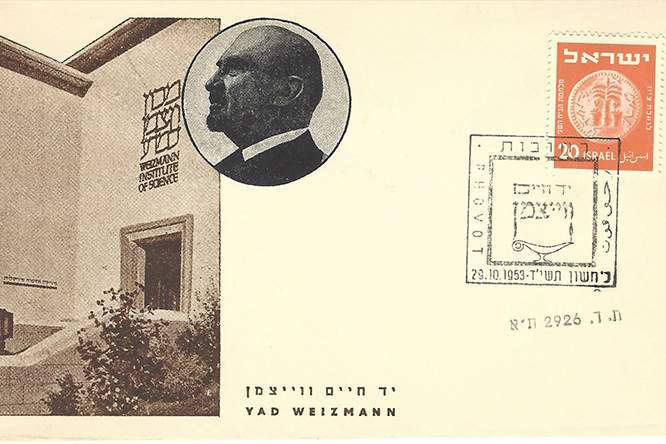
    Dr. Chaim Weizmann

    Chaim Weizmann was born in 1874 to a traditional Jewish family in the small town of Motol in White Russia (Belarus). After graduating with honors from the Real-Gymnasium in Pinsk, he decided to establish himself professionally

    More »
    Weizmann House
    • History and Architecture
    • The Collection
    • The Tour
    • The Garden
    • The Grave
    • Erich Mendelsohn
    • The Presidential Car Vintage Wheels

    Visiting the Institute


    • Visitors Center
    • Weizmann House
    • Clore Garden of Science
    |
    | | | | | |
    |
  • Weizmann Institute Homepage
Home » Press Room » Press Releases
News
  • Press Releases
    • English
    • Hebrew
    • Spanish
    • French
    • German
  • In the News
  • Subscribe to Press Releases
  • Honors and Awards
  • Visits
  • Events

twitter block


Follow @WeizmannScience

Two Antibodies Are Better Than One

07 Feb
2013
Cancer

A new approach mimicking the body’s natural defenses could help treat a therapy-resistant breast cancer

 
Cancer drugs of the new, molecular generation destroy malignant breast tumors in a targeted manner:  They block characteristic molecules on tumor cells – receptors for the hormones estrogen or progesterone, or a co-receptor, called HER2, that binds to many growth factors. But about one in every six breast tumors has none of these receptors. Such cancers, called triple-negative, are particularly aggressive and notoriously difficult to treat.

Some of these therapy-resistant cancers have a potential molecular target for cancer drugs, a growth-factor receptor called EGFR, but an EGFR-blocking drug has proved ineffective in treating them. In a study published recently in the Proceedings of the National Academy of Sciences, Weizmann Institute researchers propose a potential solution: to simultaneously treat triple-negative breast cancer with two EGFR-blocking antibodies instead of one. In a study in mice, the scientists showed that a certain combination of two antibodies indeed prevented the growth and spread of triple-negative tumors. The research team, led by Prof. Yosef Yarden of the Biological Regulation Department and Prof. Michael Sela of the Immunology Department, included Drs. Daniela Ferraro, Nadège Gaborit, Ruth Maron,  Hadas Cohen-Dvashi,  Ziv Porat and Fresia Pareja, and Sara Lavi, Dr. Moshit Lindzen and Nir Ben-Chetrit.

Of the different combinations they tried, the scientists found that the approach worked when the two antibodies bound to different parts of the EGFR molecule. The combined action of the antibodies was stronger than would have been expected by simply adding up the separate effects of each.  Apparently, the use of the two antibodies created an entirely new anti-cancer mechanism: In addition to blocking the EGFR and recruiting the help of immune cells, the antibodies probably overwhelmed the EGFR by their sheer weight, causing it to collapse inward from the membrane into the tumor cell.

 
Deprived of EGFR on its surface, the cells were no longer receiving the growth signals, preventing the growth of the tumor. This approach resembles the natural functioning of the immune system, which tends to block essential antigens at several sites by targeting them with multiple antibodies.

If supported by further studies, the two-antibody approach, in combination with chemotherapy, might in the future be developed into an effective treatment for triple-negative breast cancer.


Prof. Michael Sela is the incumbent of the W. Garfield Weston Professorial Chair of Immunology.

Prof. Yosef Yarden’s research is supported by the Dr. Miriam and Sheldon G. Adelson Medical Research Foundation; the M.D. Moross Institute for Cancer Research; the Steven and Beverly Rubenstein Charitable Foundation , Inc.; Julie Charbonneau, Canada; the European Research Council; and the Marvin Tanner Laboratory for Research on Cancer. Prof. Yarden is the incumbent of the Harold and Zelda Goldenberg Professorial Chair in Molecular Cell Biology.


Tags:
  • Breast cancer,
  • Cancer,
  • Chemotherapy,
  • Immunology,
  • Michael Sela,
  • Yosef Yarden,
  • ""
  • Print this page »

Search Press Releases

Related Articles

Scientist Named Research Leader in Nanotechnology
Two are Better than One
Genes that slows cell division
A control mechanism for metastasis
More Related links »
Gene expression in colon cancer tissue samples
Edit block | Delete block

Edit block | Delete block

Download our FREE Interface Magazine App for iPad and Android

Secondary Links

  • Contact Us
  • Visit Us
  • How to Get Here
  • Campus Map
  • Site Map
  • Privacy
  • Terms of Use
  • Supporting Committees
  • Credits

Get RSS
© Weizmann Institute of Science 2012. All rights reserved
Follow us on:
[Jump to Top] [Jump to Main Content]